Overview of the EUonQoL
Purpose of the EUonQoL IG
Importance of the EUonQoL-Kit
Value of the EUonQoL IG
Intended Users of the EUonQoL-Kit Data
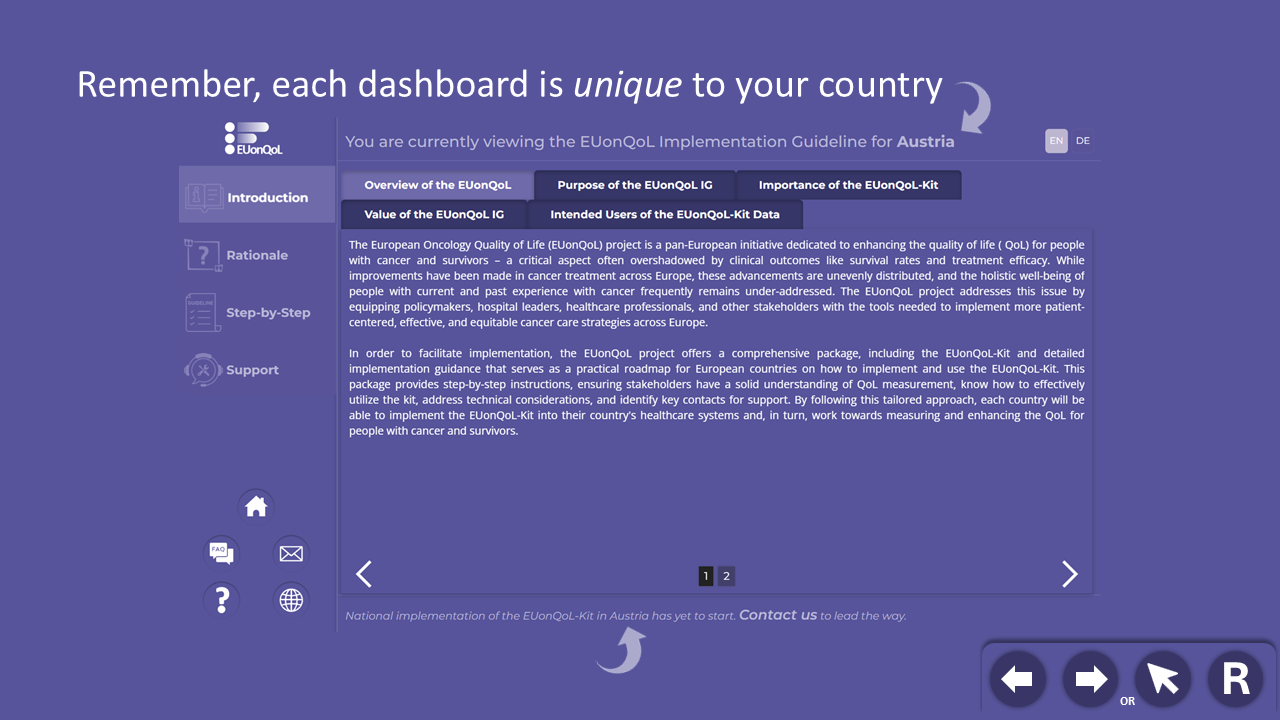
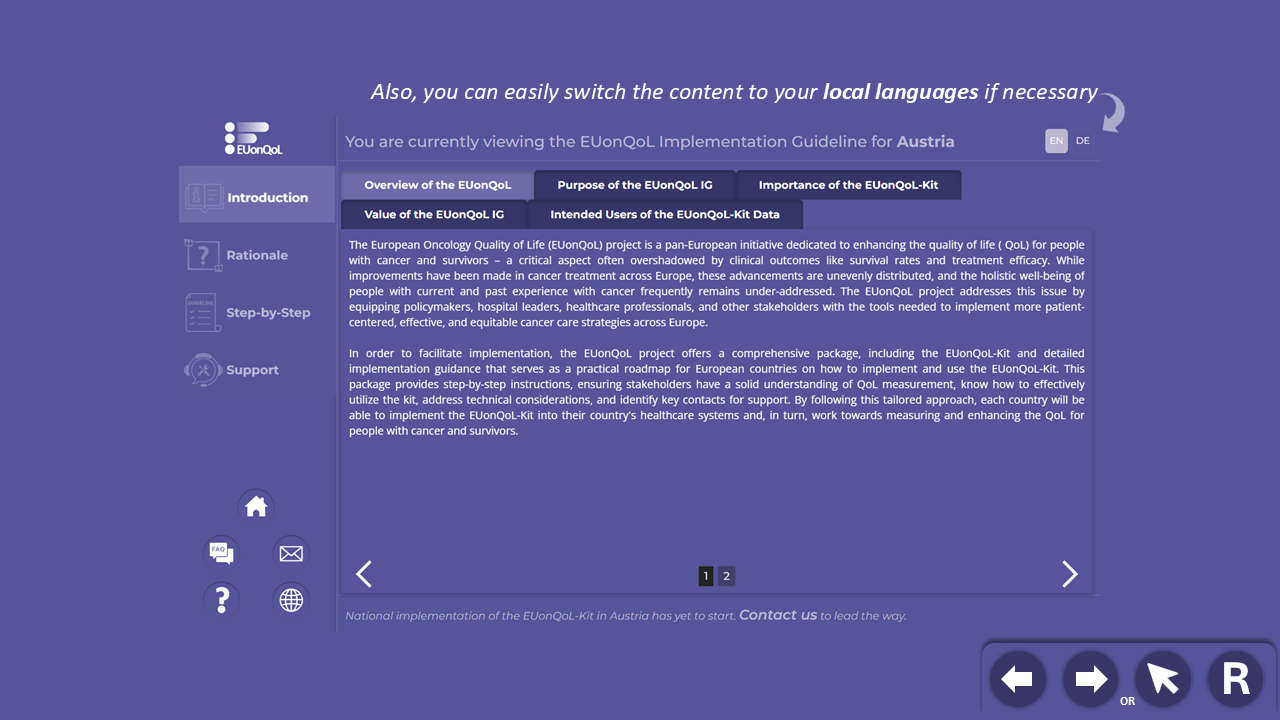
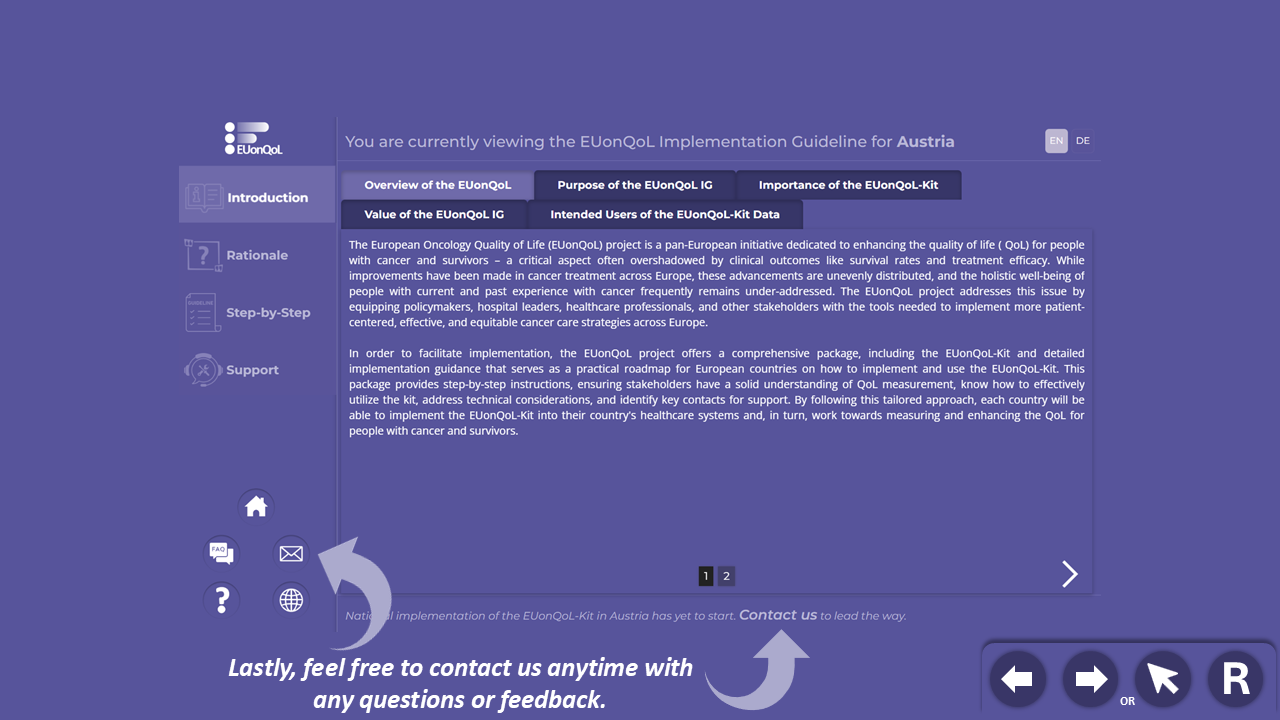
The European Oncology Quality of Life (EUonQoL) project is a pan-European initiative dedicated to enhancing the quality of life ( QoL) for people with cancer and survivors – a critical aspect often overshadowed by clinical outcomes like survival rates and treatment efficacy. While improvements have been made in cancer treatment across Europe, these advancements are unevenly distributed, and the holistic well-being of people with current and past experience with cancer frequently remains under-addressed. The EUonQoL project addresses this issue by equipping policymakers, hospital leaders, healthcare professionals, and other stakeholders with the tools needed to implement more patient-centered, effective, and equitable cancer care strategies across Europe.
In order to facilitate implementation, the EUonQoL project offers a comprehensive package, including the EUonQoL-Kit and detailed implementation guidance that serves as a practical roadmap for European countries on how to implement and use the EUonQoL-Kit. This package provides step-by-step instructions, ensuring stakeholders have a solid understanding of QoL measurement, know how to effectively utilize the kit, address technical considerations, and identify key contacts for support. By following this tailored approach, each country will be able to implement the EUonQoL-Kit into their country's healthcare systems and, in turn, work towards measuring and enhancing the QoL for people with cancer and survivors.
In order to facilitate implementation, the EUonQoL project offers a comprehensive package, including the EUonQoL-Kit and detailed implementation guidance that serves as a practical roadmap for European countries on how to implement and use the EUonQoL-Kit. This package provides step-by-step instructions, ensuring stakeholders have a solid understanding of QoL measurement, know how to effectively utilize the kit, address technical considerations, and identify key contacts for support. By following this tailored approach, each country will be able to implement the EUonQoL-Kit into their country's healthcare systems and, in turn, work towards measuring and enhancing the QoL for people with cancer and survivors.
Empty
The project aims to create the EUonQoL-Kit, a digital toolkit designed to assess QoL across all stages of the cancer journey (from treatment to survivorship and palliative care) of all Europeans. This toolkit will enable systematic and comparable aggregated data collection on QoL across different European healthcare systems.
- Culturally and linguistically adapted
- Dynamically adjustable based on user responses
- Co-created with survivors of cancer
Decision-makers can use the aggregated QoL data to make evidence-based decisions to improve cancer care and support services in their country. This data provides a foundation for healthcare policy changes related to better treatments, interventions, and patients' physical, emotional, and social well-being. Such healthcare policy strategies can be applied at the national, regional, and hospital levels.
The EUonQoL project offers an implementation guideline – a digital platform – to guide countries on implementing the EUonQoL-Kit nationally. This platform, which you currently view, will be tested and validated before being rolled to (eventually) all European countries.
- Culturally and linguistically adapted
- Dynamically adjustable based on user responses
- Co-created with survivors of cancer
Decision-makers can use the aggregated QoL data to make evidence-based decisions to improve cancer care and support services in their country. This data provides a foundation for healthcare policy changes related to better treatments, interventions, and patients' physical, emotional, and social well-being. Such healthcare policy strategies can be applied at the national, regional, and hospital levels.
The EUonQoL project offers an implementation guideline – a digital platform – to guide countries on implementing the EUonQoL-Kit nationally. This platform, which you currently view, will be tested and validated before being rolled to (eventually) all European countries.
Empty
Combined with objective aggregated metrics, such as survival rate and cure rate, aggregated QoL data can empower decision-makers to implement informed actions that can improve the well-being of cancer patients and survivors within their country.
Mapping aggregated QoL data across European countries can help highlight health inequity. This visibility allows the European Union to strategically direct resources and interventions toward countries and areas that show poor QoL outcomes in cancer patients or survivors. Governing bodies within a country can use the same approach at the regional and hospital levels.
By integrating QoL data into policy decision-making, we advance toward achieving the overarching goal of ensuring healthy lives and well-being for all at all ages (SDG3) and improving cancer care. As such, the EUonQoL-Kit facilitates the achievement of the Sustainable Development Goal 3 (SDG3), Mission on Cancer, and Europe's Beating Cancer Plan.
Mapping aggregated QoL data across European countries can help highlight health inequity. This visibility allows the European Union to strategically direct resources and interventions toward countries and areas that show poor QoL outcomes in cancer patients or survivors. Governing bodies within a country can use the same approach at the regional and hospital levels.
By integrating QoL data into policy decision-making, we advance toward achieving the overarching goal of ensuring healthy lives and well-being for all at all ages (SDG3) and improving cancer care. As such, the EUonQoL-Kit facilitates the achievement of the Sustainable Development Goal 3 (SDG3), Mission on Cancer, and Europe's Beating Cancer Plan.
Empty
CWhile the EUonQoL-Kit is the tool to measure population-level quality of life (QoL), the EUonQoL Implementation Guideline (EUonQoL IG) ensures that the EUonQoL-Kit is effectively implemented into national and regional healthcare systems across Europe. The EUonQoL IG is more than just a manual; it is a source of information that facilitates the integration of the EUonQoL-Kit and its effective and sustainable usage.
Europe's healthcare landscape is incredibly diverse, with each country possessing its own regulatory frameworks, cultural norms, and healthcare practices. The EUonQoL IG offers country-specific guidance informed by stakeholders from each EU country. This ensures that while each nation can tailor the implementation to its context, the core objectives and functionality of the EUonQoL-Kit remain consistent. The EUonQoL IG will offer:
- Help streamline the adoption of the EUonQoL-Kit, reducing barriers to implementation and ensuring that the toolkit's benefits are realized promptly across different healthcare settings.
- With standardized QoL data, policymakers, healthcare leaders, and other stakeholders can make informed decisions based on reliable, comparable insights. This data-driven approach enhances the effectiveness of health policies and resource allocation.
- By identifying and addressing disparities revealed through QoL data, the EUonQoL IG supports efforts to reduce health inequalities, aligning with broader European health initiatives to provide equitable care for all citizens.
- Technical guidance through e-learning modules and practical recommendations for sustainable use of the EUonQoL-Kit.
Europe's healthcare landscape is incredibly diverse, with each country possessing its own regulatory frameworks, cultural norms, and healthcare practices. The EUonQoL IG offers country-specific guidance informed by stakeholders from each EU country. This ensures that while each nation can tailor the implementation to its context, the core objectives and functionality of the EUonQoL-Kit remain consistent. The EUonQoL IG will offer:
- Help streamline the adoption of the EUonQoL-Kit, reducing barriers to implementation and ensuring that the toolkit's benefits are realized promptly across different healthcare settings.
- With standardized QoL data, policymakers, healthcare leaders, and other stakeholders can make informed decisions based on reliable, comparable insights. This data-driven approach enhances the effectiveness of health policies and resource allocation.
- By identifying and addressing disparities revealed through QoL data, the EUonQoL IG supports efforts to reduce health inequalities, aligning with broader European health initiatives to provide equitable care for all citizens.
- Technical guidance through e-learning modules and practical recommendations for sustainable use of the EUonQoL-Kit.
The EUonQoL IG will undergo comprehensive validation across multiple European countries to ensure their applicability and effectiveness in real-world settings. The rollout of the EUonQoL IG is structured in four progressive stages:
These stages are work in progress. We would like to hear your opinions, both textual and conceptual. Also, please share your suggestion on where it could be placed in the EUonQoL IG if we were to have it.
Stage 1: Facilitated National Implementation: A select group of countries will collaborate directly with the EUonQoL team to implement the EUonQoL-Kit nationally using the EUonQoL IG while adjusting the guideline iteratively. During this stage, EUonQoL members will work closely with the national working group responsible for deploying the EUonQoL-Kit in a given country, providing hands-on support and making real-time adjustments based on feedback and observations.
Stage 2: Observed national implementation: Following the initial stage, a subsequent set of countries will implement the EUonQoL-Kit nationally by adhering to the newer version of EUonQoL IG (based on the experience from Stage ). The EUonQoL team will primarily observe the progress, offering assistance when necessary. This allows for a more autonomous implementation while ensuring adherence to the guidelines and addressing emerging challenges.
Stage 3: Scaling to all EU Member states: After completing Stages 1 and 2 and incorporating feedback to refine the EUonQoL IG, the remaining EU Member States will proceed with national implementation. The EUonQoL IG will serve as a comprehensive and validated roadmap, facilitating a streamlined rollout across diverse EU healthcare systems and ensuring consistency in QoL data collection.
Steg 4: Scaling to the whole of Europe: While the fourth stage extends beyond the project's current timeframe, it remains a crucial ambition to improve cancer care for the whole of Europe. The objective is to engage stakeholders outside the initial timeframe of the project. These stakeholders will follow the same process in acquiring and forming guidance for the remaining European countries and ensuring implementation is achieved.
These stages are work in progress. We would like to hear your opinions, both textual and conceptual. Also, please share your suggestion on where it could be placed in the EUonQoL IG if we were to have it.
Stage 1: Facilitated National Implementation: A select group of countries will collaborate directly with the EUonQoL team to implement the EUonQoL-Kit nationally using the EUonQoL IG while adjusting the guideline iteratively. During this stage, EUonQoL members will work closely with the national working group responsible for deploying the EUonQoL-Kit in a given country, providing hands-on support and making real-time adjustments based on feedback and observations.
Stage 2: Observed national implementation: Following the initial stage, a subsequent set of countries will implement the EUonQoL-Kit nationally by adhering to the newer version of EUonQoL IG (based on the experience from Stage ). The EUonQoL team will primarily observe the progress, offering assistance when necessary. This allows for a more autonomous implementation while ensuring adherence to the guidelines and addressing emerging challenges.
Stage 3: Scaling to all EU Member states: After completing Stages 1 and 2 and incorporating feedback to refine the EUonQoL IG, the remaining EU Member States will proceed with national implementation. The EUonQoL IG will serve as a comprehensive and validated roadmap, facilitating a streamlined rollout across diverse EU healthcare systems and ensuring consistency in QoL data collection.
Steg 4: Scaling to the whole of Europe: While the fourth stage extends beyond the project's current timeframe, it remains a crucial ambition to improve cancer care for the whole of Europe. The objective is to engage stakeholders outside the initial timeframe of the project. These stakeholders will follow the same process in acquiring and forming guidance for the remaining European countries and ensuring implementation is achieved.
The data collected through the EUonQoL-Kit plays a pivotal role in enhancing cancer care across Europe by providing comprehensive insights into the quality of life (QoL) of individuals affected directly by cancer. This aggregated QoL data is intended for use by various stakeholders, including policymakers, healthcare providers, researchers, and patient advocacy groups, to inform decisions and strategies that improve patient outcomes and societal well-being.
National, regional, and local policymakers are primary users of the aggregated QoL data. By analyzing this data, they can make informed decisions to enhance healthcare systems and develop policies that directly improve patients' physical, emotional, and social well-being.
Patient advocacy organizations and non-governmental organizations can leverage the QoL data to advocate for Patient Needs, develop support programs, and raise awareness.
The research community can use the rich, standardized QoL data to advance cancer care knowledge, inform evidence-based practices, and facilitate international collaboration.
Healthcare professionals, including oncologists, general practitioners, nurses, and allied health workers, can utilize the aggregated QoL data to enhance patient care by tailoring treatment plans, improving clinical outcomes, and enhancing patient-centered care.
National, regional, and local policymakers are primary users of the aggregated QoL data. By analyzing this data, they can make informed decisions to enhance healthcare systems and develop policies that directly improve patients' physical, emotional, and social well-being.
Patient advocacy organizations and non-governmental organizations can leverage the QoL data to advocate for Patient Needs, develop support programs, and raise awareness.
The research community can use the rich, standardized QoL data to advance cancer care knowledge, inform evidence-based practices, and facilitate international collaboration.
Healthcare professionals, including oncologists, general practitioners, nurses, and allied health workers, can utilize the aggregated QoL data to enhance patient care by tailoring treatment plans, improving clinical outcomes, and enhancing patient-centered care.
The EUonQoL IG will undergo comprehensive validation across multiple European countries to ensure their applicability and effectiveness in real-world settings. The rollout of the EUonQoL IG is structured in four progressive stages:
These stages are work in progress. We would like to hear your opinions, both textual and conceptual. Also, please share your suggestion on where it could be placed in the EUonQoL IG if we were to have it.
Stage 1: Facilitated National Implementation: A select group of countries will collaborate directly with the EUonQoL team to implement the EUonQoL-Kit nationally using the EUonQoL IG while adjusting the guideline iteratively. During this stage, EUonQoL members will work closely with the national working group responsible for deploying the EUonQoL-Kit in a given country, providing hands-on support and making real-time adjustments based on feedback and observations.
Stage 2: Observed national implementation: Following the initial stage, a subsequent set of countries will implement the EUonQoL-Kit nationally by adhering to the newer version of EUonQoL IG (based on the experience from Stage ). The EUonQoL team will primarily observe the progress, offering assistance when necessary. This allows for a more autonomous implementation while ensuring adherence to the guidelines and addressing emerging challenges.
Stage 3: Scaling to all EU Member states: After completing Stages 1 and 2 and incorporating feedback to refine the EUonQoL IG, the remaining EU Member States will proceed with national implementation. The EUonQoL IG will serve as a comprehensive and validated roadmap, facilitating a streamlined rollout across diverse EU healthcare systems and ensuring consistency in QoL data collection.
Steg 4: Scaling to the whole of Europe: While the fourth stage extends beyond the project's current timeframe, it remains a crucial ambition to improve cancer care for the whole of Europe. The objective is to engage stakeholders outside the initial timeframe of the project. These stakeholders will follow the same process in acquiring and forming guidance for the remaining European countries and ensuring implementation is achieved.
These stages are work in progress. We would like to hear your opinions, both textual and conceptual. Also, please share your suggestion on where it could be placed in the EUonQoL IG if we were to have it.
Stage 1: Facilitated National Implementation: A select group of countries will collaborate directly with the EUonQoL team to implement the EUonQoL-Kit nationally using the EUonQoL IG while adjusting the guideline iteratively. During this stage, EUonQoL members will work closely with the national working group responsible for deploying the EUonQoL-Kit in a given country, providing hands-on support and making real-time adjustments based on feedback and observations.
Stage 2: Observed national implementation: Following the initial stage, a subsequent set of countries will implement the EUonQoL-Kit nationally by adhering to the newer version of EUonQoL IG (based on the experience from Stage ). The EUonQoL team will primarily observe the progress, offering assistance when necessary. This allows for a more autonomous implementation while ensuring adherence to the guidelines and addressing emerging challenges.
Stage 3: Scaling to all EU Member states: After completing Stages 1 and 2 and incorporating feedback to refine the EUonQoL IG, the remaining EU Member States will proceed with national implementation. The EUonQoL IG will serve as a comprehensive and validated roadmap, facilitating a streamlined rollout across diverse EU healthcare systems and ensuring consistency in QoL data collection.
Steg 4: Scaling to the whole of Europe: While the fourth stage extends beyond the project's current timeframe, it remains a crucial ambition to improve cancer care for the whole of Europe. The objective is to engage stakeholders outside the initial timeframe of the project. These stakeholders will follow the same process in acquiring and forming guidance for the remaining European countries and ensuring implementation is achieved.
Bridging Gaps in QoL Measurement
Alignment with Key European Health Policies
Benefits to Healthcare Systems
In the current European healthcare landscape, assessments of quality of life (QoL) for people with cancer and survivors are inconsistent and fragmented. While various tools exist to measure different aspects of QoL, their application varies widely across countries and healthcare systems. This inconsistency presents significant challenges to healthcare providers and policymakers who require reliable, standardized data to make informed patient care and resource allocation decisions.
- The absence of a unified QoL assessment framework creates gaps in understanding and addressing patient well-being. Many existing QoL tools fail to capture the full range of physical, emotional, spiritual, and social challenges that individuals face after being diagnosed with cancer. Moreover, these tools often lack adaptation to Europe's cultural and linguistic diversity, limiting their utility for cross-border comparisons and research.
- The EUonQoL project addresses these gaps by providing a standardized, adaptable framework for measuring QoL across Europe. The EUonQoL-Kit offers a unified approach that ensures QoL data can be consistently collected, analyzed, and compared across different healthcare systems and countries. Standardization is critical for improving patient care at the national level and enabling large-scale research that can inform Europe-wide health policies and interventions.
- The absence of a unified QoL assessment framework creates gaps in understanding and addressing patient well-being. Many existing QoL tools fail to capture the full range of physical, emotional, spiritual, and social challenges that individuals face after being diagnosed with cancer. Moreover, these tools often lack adaptation to Europe's cultural and linguistic diversity, limiting their utility for cross-border comparisons and research.
- The EUonQoL project addresses these gaps by providing a standardized, adaptable framework for measuring QoL across Europe. The EUonQoL-Kit offers a unified approach that ensures QoL data can be consistently collected, analyzed, and compared across different healthcare systems and countries. Standardization is critical for improving patient care at the national level and enabling large-scale research that can inform Europe-wide health policies and interventions.
EMPTY
The development and implementation of the EUonQoL-Kit align closely with key European health initiatives, such as Europe's Beating Cancer Plan, the EU Mission on Cancer, and the Sustainable Development Goal 3 (SDG3).
- Europe's Beating Cancer Plan: This plan outlines a comprehensive strategy to improve cancer prevention, diagnosis, treatment, and survivorship across Europe. Central to this plan is the recognition that cancer care must be patient-centered and address the full spectrum of a patient's needs. By integrating the EUonQoL-Kit into cancer care, the project supports this objective by ensuring that QoL is consistently measured and addressed throughout all stages of the cancer journey.
- EU Mission on Cancer: Emphasizing innovative, data-driven approaches to cancer care, the EU Mission on Cancer highlights the importance of improving patient well-being. By collecting standardized QoL data across Europe, the EUonQoL project enables healthcare systems to track progress toward the mission's goals. It also provides policymakers with insights to develop targeted interventions that enhance both the length and QoL for people with cancer and survivors.
- Sustainable Development Goal 3 and Universal Health Coverage: SDG3 aims to ensure healthy lives and promote well-being for all at all ages. The standardized QoL data collected through the EUonQoL-Kit supports this goal by evaluating cancer care not only in terms of survival rates but also in how it enhances patients' overall QoL. This approach aligns with the World Health Organization's objective of achieving Universal Health Coverage (UHC), which emphasizes improved societal well-being. While traditional objective measures like survival and cure rates are essential for assessing a country's health system performance, QoL is an overlooked and equally important indicator. The EUonQoL-Kit fills this gap by providing the means to collect and systematically incorporate QoL data into health system assessments. This enables policymakers and healthcare leaders to gain a more comprehensive understanding of their health systems, facilitating more effective policy decisions that improve both health system performance and societal well-being.
- Europe's Beating Cancer Plan: This plan outlines a comprehensive strategy to improve cancer prevention, diagnosis, treatment, and survivorship across Europe. Central to this plan is the recognition that cancer care must be patient-centered and address the full spectrum of a patient's needs. By integrating the EUonQoL-Kit into cancer care, the project supports this objective by ensuring that QoL is consistently measured and addressed throughout all stages of the cancer journey.
- EU Mission on Cancer: Emphasizing innovative, data-driven approaches to cancer care, the EU Mission on Cancer highlights the importance of improving patient well-being. By collecting standardized QoL data across Europe, the EUonQoL project enables healthcare systems to track progress toward the mission's goals. It also provides policymakers with insights to develop targeted interventions that enhance both the length and QoL for people with cancer and survivors.
- Sustainable Development Goal 3 and Universal Health Coverage: SDG3 aims to ensure healthy lives and promote well-being for all at all ages. The standardized QoL data collected through the EUonQoL-Kit supports this goal by evaluating cancer care not only in terms of survival rates but also in how it enhances patients' overall QoL. This approach aligns with the World Health Organization's objective of achieving Universal Health Coverage (UHC), which emphasizes improved societal well-being. While traditional objective measures like survival and cure rates are essential for assessing a country's health system performance, QoL is an overlooked and equally important indicator. The EUonQoL-Kit fills this gap by providing the means to collect and systematically incorporate QoL data into health system assessments. This enables policymakers and healthcare leaders to gain a more comprehensive understanding of their health systems, facilitating more effective policy decisions that improve both health system performance and societal well-being.
EMPTY
Implementing the EUonQoL-Kit offers numerous benefits to healthcare systems, policymakers, and patients.
- Enhancing patient care: By incorporating QoL data into clinical decision-making, healthcare providers can identify areas where patients and families ??? struggle on the physical, emotional, or social level and tailor their care accordingly. This facilitated a patient-centered approach and, in turn, can improve the effectiveness of cancer treatments and the overall patient experience.
- Informed policy decisions: The standardized data collected through the EUonQoL-Kit provides policymakers with valuable insights for national health policy and decision-making. QoL data can reveal disparities in care, identify areas where resources are lacking, and inform the development of policies that promote equitable access to cancer care services. By integrating QoL measures into national health systems data collection, policymakers can ensure that healthcare interventions not only extend lives but also improve the quality of those lives.
- Facilitating cross-border collaboration: Countries can adopt best practices from one another to enhance their own cancer care services, leading to a more cohesive and effective European approach to cancer care.
- Optimizing resource allocation: Understanding where QoL outcomes are poorest enables healthcare providers and policymakers to target interventions and resources effectively. This ensures that patients who need additional support receive it, leading to more efficient use of healthcare resources and improved patient satisfaction and outcomes.
- Enhancing patient care: By incorporating QoL data into clinical decision-making, healthcare providers can identify areas where patients and families ??? struggle on the physical, emotional, or social level and tailor their care accordingly. This facilitated a patient-centered approach and, in turn, can improve the effectiveness of cancer treatments and the overall patient experience.
- Informed policy decisions: The standardized data collected through the EUonQoL-Kit provides policymakers with valuable insights for national health policy and decision-making. QoL data can reveal disparities in care, identify areas where resources are lacking, and inform the development of policies that promote equitable access to cancer care services. By integrating QoL measures into national health systems data collection, policymakers can ensure that healthcare interventions not only extend lives but also improve the quality of those lives.
- Facilitating cross-border collaboration: Countries can adopt best practices from one another to enhance their own cancer care services, leading to a more cohesive and effective European approach to cancer care.
- Optimizing resource allocation: Understanding where QoL outcomes are poorest enables healthcare providers and policymakers to target interventions and resources effectively. This ensures that patients who need additional support receive it, leading to more efficient use of healthcare resources and improved patient satisfaction and outcomes.
EMPTY
Overview
EUonQoL-Kit Technical Setup
Expert Implementation Insight
National Stakeholder Insights
Supporting Research and Documentation
The implementation of the EUonQoL-Kit follows a structured and methodical approach designed to facilitate tailored integration across different healthcare systems in Europe. In this section, you will find the technical and national instructions. The national implementation is based on expert recommendations on factors required for implementation and country-specific factors for the given country. The section also provides a subsection on the research and documentation behind this step-by-step reasoning.
- The introductory steps are developed together with those who will use the implementation instructions.
- Each country will have its own country-specific section adjusted to its healthcare system infrastructure and translated into its own language.
- The EUonQoL IG facilitates collaboration between those who have managed to achieve implementation and those currently undergoing implementation.
- The introductory steps are developed together with those who will use the implementation instructions.
- Each country will have its own country-specific section adjusted to its healthcare system infrastructure and translated into its own language.
- The EUonQoL IG facilitates collaboration between those who have managed to achieve implementation and those currently undergoing implementation.
EMPTY
Setting up the EUonQoL-Kit is crucial to ensure secure and efficient collection, storage, and management of QoL data for people with cancer and survivors across Europe. This section provides detailed instructions for technically installing and configuring the EUonQoL-Kit.
[THIS SUBSECTION WILL BE REPLACED BY E-LEARNING PROGRAMME]
[THIS SUBSECTION WILL BE REPLACED BY E-LEARNING PROGRAMME]
NA
This subsection is part of a two-pronged approach to guide countries on implementing the EUonQoL-Kit into their national health data systems, combining expert recommendations with national stakeholder insights.
National insights are crucial for tailoring the implementation of the EUonQoL-Kit to each country's specific context. We have collected this insight from key stakeholders from every given country. Below, you will find the suggested method of national implementation.
National insights are crucial for tailoring the implementation of the EUonQoL-Kit to each country's specific context. We have collected this insight from key stakeholders from every given country. Below, you will find the suggested method of national implementation.
EMPTY
This section is part of a two-pronged approach to guide countries on implementing the EUonQoL-Kit into their national health data systems, combining expert recommendations with national stakeholder insights.
Before adopting the EUonQoL-Kit, countries should evaluate their healthcare systems to determine their readiness for implementing a nationwide, digital-based quality of life (QoL) assessment tool. This comprehensive assessment ensures that the necessary governmental support, healthcare infrastructure, and technological capabilities are in place for a successful rollout. By conducting a thorough readiness evaluation and leveraging insights from national stakeholders, countries can tailor the integration of the EUonQoL-Kit to their specific contexts. This proactive approach addresses potential challenges, facilitates effective adoption, and ultimately enhances the QoL for people with cancer and survivors across Europe.
- Understanding the country's readiness allows policymakers and healthcare leaders to make evidence-based decisions regarding resource allocation and implementation strategies.
- Identifying potential barriers in advance reduces the risk of implementation challenges, ensuring the EUonQoL-Kit can deliver its intended benefits effectively.
Tailoring the integration process based on readiness assessments leads to a more efficient and effective rollout, addressing specific needs and constraints of the national healthcare system.
Before adopting the EUonQoL-Kit, countries should evaluate their healthcare systems to determine their readiness for implementing a nationwide, digital-based quality of life (QoL) assessment tool. This comprehensive assessment ensures that the necessary governmental support, healthcare infrastructure, and technological capabilities are in place for a successful rollout. By conducting a thorough readiness evaluation and leveraging insights from national stakeholders, countries can tailor the integration of the EUonQoL-Kit to their specific contexts. This proactive approach addresses potential challenges, facilitates effective adoption, and ultimately enhances the QoL for people with cancer and survivors across Europe.
- Understanding the country's readiness allows policymakers and healthcare leaders to make evidence-based decisions regarding resource allocation and implementation strategies.
- Identifying potential barriers in advance reduces the risk of implementation challenges, ensuring the EUonQoL-Kit can deliver its intended benefits effectively.
Tailoring the integration process based on readiness assessments leads to a more efficient and effective rollout, addressing specific needs and constraints of the national healthcare system.
EMPTY
The EUonQoL-Kit's success lies in its implementation and the ongoing research and evaluation that supports its national rollout.
(This subsection will be supplemented with detailed documentation on the progress of national implementations in different countries. Over time, it will also include research and insights into how the implementation readiness/maturity model was developed. As consortium partners publish deliverables and scientific papers relevant to the national-level implementation process, or as we identify relevant external resources, these will be added here.)
(This subsection will be supplemented with detailed documentation on the progress of national implementations in different countries. Over time, it will also include research and insights into how the implementation readiness/maturity model was developed. As consortium partners publish deliverables and scientific papers relevant to the national-level implementation process, or as we identify relevant external resources, these will be added here.)
EMPTY
The successful integration of the EUonQoL-Kit into diverse European healthcare systems requires robust technical support. Recognizing the complexities involved, the EUonQoL Implementation Guidelines (IG) include a comprehensive technical support framework to assist stakeholders throughout the implementation process.
(This subsection depends on what our "technical department". The text below is a suggestion, but it will depend on what we can offer.)
- Stakeholders have access to specialized technical support teams with deep expertise in both the technical and clinical aspects of the EUonQoL-Kit.
- These teams provide step-by-step assistance with software installation, system configuration, and troubleshooting.
- Tailored solutions are offered to address specific technical challenges unique to each country's healthcare infrastructure.
- An online help desk is available around the clock, offering real-time support through a user-friendly web-based platform.
- Users can access a comprehensive library of FAQs, tutorials, and troubleshooting guides.
(This subsection depends on what our "technical department". The text below is a suggestion, but it will depend on what we can offer.)
- Stakeholders have access to specialized technical support teams with deep expertise in both the technical and clinical aspects of the EUonQoL-Kit.
- These teams provide step-by-step assistance with software installation, system configuration, and troubleshooting.
- Tailored solutions are offered to address specific technical challenges unique to each country's healthcare infrastructure.
- An online help desk is available around the clock, offering real-time support through a user-friendly web-based platform.
- Users can access a comprehensive library of FAQs, tutorials, and troubleshooting guides.
EMPTY
Beyond technical assistance, practical support is crucial for stakeholders embarking on implementing the EUonQoL-Kit nationally into their country. The EUonQoL IG offers resources to facilitate connections between stakeholders and their peers who have either successfully implemented or are currently implementing the EUonQoL-Kit.
- Stakeholders can connect with representatives from countries already implementing the EUonQoL-Kit to share insights and best practices.
- This peer-to-peer support enables new implementers to learn from real-world experiences, enhancing the efficiency and effectiveness of their own implementation efforts.
- A platform where such collaboration can be shared, such as forums, workshops, or webinars.
- Real-world examples from early adopters illustrate successful strategies and common challenges.
- Each country has designated contacts (EUonQoL National-level Advisory Group members – provided they consent) who can provide tailored advice and support based on specific national contexts. Stakeholders can contact these contacts for personalized guidance and to address country-specific questions or concerns.
- Stakeholders can connect with representatives from countries already implementing the EUonQoL-Kit to share insights and best practices.
- This peer-to-peer support enables new implementers to learn from real-world experiences, enhancing the efficiency and effectiveness of their own implementation efforts.
- A platform where such collaboration can be shared, such as forums, workshops, or webinars.
- Real-world examples from early adopters illustrate successful strategies and common challenges.
- Each country has designated contacts (EUonQoL National-level Advisory Group members – provided they consent) who can provide tailored advice and support based on specific national contexts. Stakeholders can contact these contacts for personalized guidance and to address country-specific questions or concerns.
NA